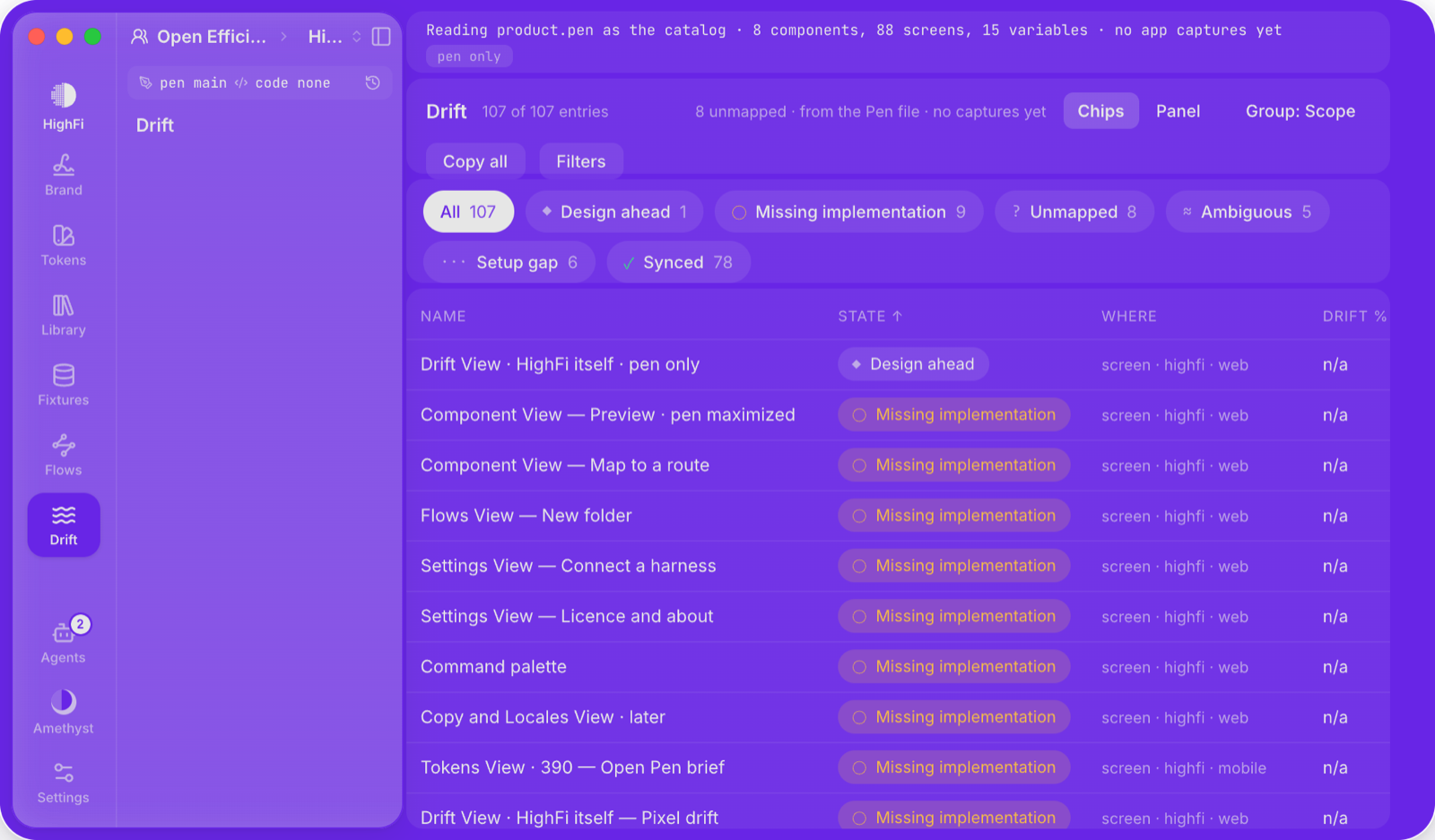
HighFi, checking its own design
The real app, running on HighFi's own Pen file and code. Click around: Drift, the Library, Tokens, Flows. It's read only here; download it to run it on your code.
Import, see drift, resolve toward one side, approve, seal.
A lock between a design file and the code that renders it. Design and code drift silently, and coding agents make the code side move faster every month.
- ImportPoint HighFi at your frontend repository and your Pen file. It detects your framework.
- See driftEvery component and screen gets a state, with hash and pixel evidence.
- ResolveSend a row to your coding agent, or a brief to Pen for the design side.
- ApproveRead the diff. Nothing is committed or pushed until you approve it.
- SealAttest the match. The lock records it in your repository.
Design and code never drift apart in silence.
Proof over promise
We show evidence: hashes, captures, tests, numbers. A claim without evidence is a question.
People decide
Agents propose and do the work; a person approves every commit, push, seal and design change.
Yours stays yours
Work stays on the team's machine and in its repository, in open files; no accounts, no telemetry.
Teams who design in Pen and ship with code, and the people between those two worlds.
Design engineers and product designers who own a design system.
Frontend teams who use coding agents and need to know what the agents changed.
Founders and small studios running several products; our own first: Open Efficiency (HighFi), Otto (Otto Marketplace, GoBookIt.ai, Candid), Efficiency Ventures (MVP Stadium).
On the team's own machine and in their repository; nothing leaves either.
The app runs at localhost; phones on the same network can open it.
A Rust engine at the core, a local web app around it, adapters at the edges.
The Rust engine (hifi) owns the canonical model, hashes, locks and seals; it is the boundary the app builds against (D-63).
Your framework, your library
React, Next.js and Rails first; Swift and Flutter next. HighFi writes your component library in your own stack.
Buy it once. Keep it.
A perpetual licence with a year of updates. The licence key is checked on your machine, so there are no accounts and no subscription. Every plan starts with a 14-day trial per project.
Non-commercial
- Personal projects, students, non-profits
- Every feature
- 12 months of updates
Commercial
- For teams shipping products
- Every feature, every adapter
- 12 months of updates
Team of three
- Three commercial seats
- Extra seats at $499
- 12 months of updates
Production onboarding for outside teams by 13 October
A team outside ours installs HighFi, points it at its frontend repository and its Pen file, and within a working day sees every component and screen with a drift state, fixes drift through an approved agent run, and seals what matches, with a licence key.
We build HighFi with HighFi, in the open. The live roadmap shows every decision, plan and branch.